
Soefia Research
Government supports one‑in‑three U.S. jobs.
And that can shape which skills are valued in the workforce.
Much of today's conversation is about how AI is changing work and which skills people will need in the economy of the future. But let's look at a critical fact about the current U.S. economy already influencing the demand for workforce skills: one-third of U.S. employment as of 2024 was supported by public institutions and governments at the federal, state, or local levels (collectively "Government").
49.9M
Payroll jobs supported by Government
31.9% of U.S. payroll jobs
46.0M
Full-time equivalents (FTEs)
31.7% of U.S. FTEs
49.5M
Individual people employed
30.4% of employed people
Key findings
Where the 50 million jobs come from.
The report measures three types of Government-supported employment: payroll jobs, full-time equivalents, and employed people.
Direct employment
People employed directly by Government, including active-duty military. That's the size of Government payrolls alone.
23.7M
15.2% of payroll jobs
Funded by public purchases
Jobs paid for by Government purchases, including public health programs, from defense contractors to hospitals.
18.0M
11.5% of payroll jobs
Supply-chain employment
Jobs supplying the inputs used to produce the goods and services that Government buys.
8.2M
5.3% of payroll jobs
In perspective
Office buildings the size of four states.
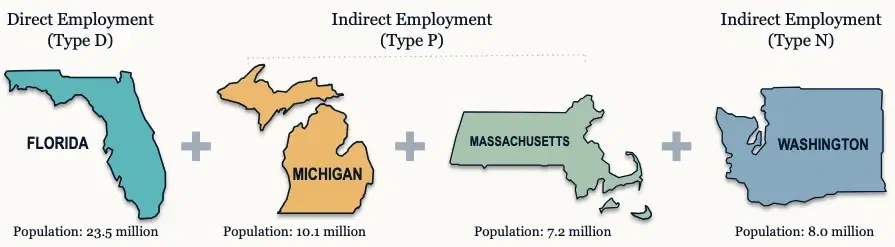
Imagine every resident of Florida, of every age, working in a single office building. That's the size of current Government payrolls. Add the jobs funded by Government purchases: another building the size of Michigan and Massachusetts combined. Then add the supply-chain jobs behind those purchases: the state of Washington.
What it means for the future of work
The wrong incentives build the wrong skills.
Eisenhower warned of a "military-industrial complex." What are the risks of a "government-industrial complex"? When so much employment ultimately depends on one sector, especially one with unique characteristics such as being shielded from insolvency and facing limited competition, the skills it rewards shape the whole workforce.
Competencies associated with winning a share of existing resources would seem encouraged over those associated with producing additional resources.
Does that create greater employment risk as AI adoption grows and affects all work? This isn't a political question. It's about what we want to learn to do, which competencies we need to develop to do those things, and how we'll use them to build successful lives. That's straightforward talent management and development.
The full report
Get the complete analysis.
- The full methodology and data sources behind all three measures
- Direct Government employment by function, at the federal, state, and local levels
- Government-funded and supply-chain jobs by sector, including defense and infrastructure
- A detailed look at healthcare, the largest Government-funded sector
- The skills that increase and decrease in value in a Government-supported economy
- The implications for workforce competencies in an AI economy
Soefia Research Report
Government Supports One-in-Three Jobs in the U.S.
About the author

Alan Canzano
Co-founder, Soefia
Alan Canzano co-founded Soefia to help organizations stop wasting people on unproductive work and move from job-based "fit" to skills-based adaptability. He spent more than 15 years in large enterprises, including Goldman Sachs, Cronus, Demandware, Salesforce, and EngageSmart, and has worked on dozens of business transformations. His takeaway: the best outcomes came from teams with real skills, especially adaptability, not the most impressive titles or experience.
A reformed investment banker and former lawyer, Alan is a graduate of Harvard Law School, Yale University, and Princeton University; a two-time founder; and a Transcend Network Fellow. He lives outside Boston.
About the data. Calendar year 2024, except certain federal fiscal data where noted in the full report. Analysis of the BLS Quarterly Census of Employment and Wages, BLS input-output matrices, the BLS Current Population Survey, BEA data, and CMS National Health Expenditures. Totals may not sum due to rounding.